


This week we chat with actor and theatre maker (and we all know her as a Croydonites co-director) Katie Hurley, about her new play created with Sarah Hehir, as they prepare to take it to Edinburgh Fringe this summer.
Croydonist: First things first – why is the play called ‘Man or Bear’? 🙂
Katie: We named the show ‘Man or Bear’ after a viral TikTok trend of the same name, which fed into the inspiration for the show.

Croydonist: For anyone who hasn’t come across the viral TikTok question, can you explain the premise behind it – and what made you want to turn that idea into theatre?
Katie: So basically, a group of women were asked if they would rather be stuck alone in the woods with a man or a bear. And around 90% of the women said bear. With some of their reasoning being things like: if a bear attacked me, people would believe me; if a bear attacked me, no-one would ask me what I was wearing; if a bear attacked me, no-one would say, think of the bear’s future.
Not only did we deeply resonate with their responses but we were also quite horrified by some of the male responses to their explanations which ranged anywhere from really patronising information about how dangerous bears are, to “You stupid bitch, you’d much rather I raped you than be left alone with a bear.”
No one is saying that they want to be left alone with a bear. I think what the crux of the question was basically underlining is that you know where you’re at with a bear and you don’t necessarily know where you’re at with a man. There’s not a uniform for a rapist or a predator. And actually, sometimes the not knowing is worse, because you’re always having to be on high alert.
Sarah and I came across the trend whilst in the early stages of our research. We already knew we wanted the play to be around themes of violence against women and girls so this discovery fed into the inspiration for what the show went on to be.

Croydonist: The play sounds like it moves between comedy, surrealism and something much darker. How did you approach getting that balance right?
Katie: So the show essentially moves between three different styles. The core one being a traditional contemporary drama, where we follow the lives of three women (Connie, Angel, and Paige). Angel is a teenager, Paige is her mother, and Connie is their neighbour. We were trying to lean into unhelpful stereotypes around women, like ‘virgin, mother, crone.’
We have sections of narration, where we find out more about each of the characters’ backstories. And then these are punctuated by surreal moments where we use the metaphor of the bear as a representation of the threat women face. Those moments are more movement-based, absurd and quite silly and playful; at first they draw the audience into thinking they’re being entertained and they respond to this and then ultimately, they realise that they’re not. These audience interactions represent elements of escalating coercive control and toxic relationships.
One of the reasons we use contemporary drama as a form, is because people have become so accustomed to seeing images of women all over news apps or TV screens, women who have experienced violent, horrific acts, often murdered by partners mainly, but occasionally sons, colleagues or strangers. We wanted the audience to fall in love with these characters and really get to know them, so that when they see these women in danger, they feel like they want to do something about it.
We played a lot during the process of creating this show and the comedy came organically from the dynamics between these three women: three dimensional characters rather than the patriarchal archetypes they represent.

Croydonist: You’ve co-created the show with Sarah Hehir. How do the two of you work together creatively – and did either of you surprise the other during the development process?
Katie: This is actually the third show that Sarah and I have worked on together. Our first piece, ‘Zero Down’, we took to Edinburgh in 2016, and that was another all-female three-hander, following the lives of three care home workers on zero-hour contracts. Our second piece was an adaptation of a real-life story called ‘The Deed’, which we developed with actors in Kosovo.
This time, we had a really clear intention. We often make work that is female-led and comes from a place of anger. I’m always in awe of Sarah’s talent and ability as a writer. She’s also incredibly compassionate and skilled as a workshop facilitator, and she’s a great collaborator.
We work really well together. We’re good at taking what I think the piece should be and what she thinks the piece should be and combining those ideas, and something quite magical happens when we do that.
Something I feel we do particularly well is character. We really delve into the bones of them so they’re fully fleshed out and realised. Some of the feedback we’ve had from work-in-progress showings is how rich the characters are.
We want to make sure that, because there are still far fewer roles for women, particularly older women – than men, the ones we create are rich and an actor’s dream to play.

Croydonist: The show has been developed through workshops and R&D sessions across Croydon and Medway. Did those community conversations shape the script in unexpected ways?
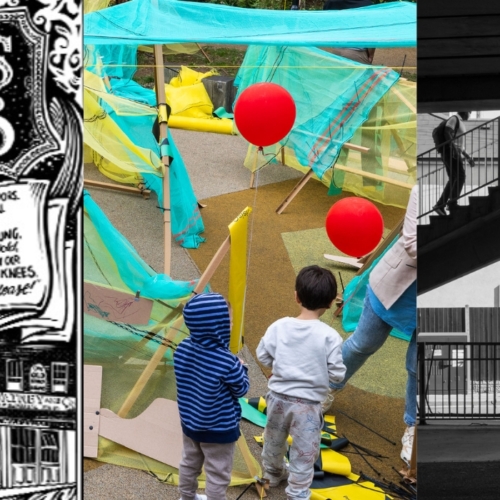
Katie: We worked with young people in schools and colleges around envisaging what a utopian future for women would look like, and then with participants aged 18+ exploring unhelpful gender stereotypes.
We weren’t really surprised by some of the feedback but we were shocked at how common and prevalent experiences of abuse, coercion and domestic abuse were.
The most surprising thing was working with young people and how clued up they were around unhealthy relationships, way more than Sarah or I would have been at their age. They had language for things we didn’t.
But they also have the added difficulty of growing up in the age of social media where abuse can be much more immediate and intrusive. Some of the girls told us they were receiving DMs from much older men with explicit images from the age of 14, which I found quite horrific.

Croydonist: Your previous show You’re SO F**KING Croydon! had such a strong sense of place and voice. Does Croydon influence this work too, even though the themes are much broader?
Katie: Oh yeah, absolutely. I can’t help but have Croydon embedded in my work because it’s my lived experience. And similarly with Sarah living in Medway and growing up near Scunthorpe, there are differences between the communities, but also similarities.
When we were writing the funding application, it was at a time when Elianne had just been brutally murdered, which shook the whole community deeply. I was working at a youth club at the time and saw the impact it had on young people who were her peers. It also brought me back to when I was 18 and the murder of Sally Ann Bowman in Croydon. I was the same age as her. It was very close to where I was living and going out and it was the first time I really understood how close violence can feel and how alert you have to be as a woman.
We also did R&D in Croydon, held rehearsals there and invited local services around violence and domestic abuse to our work-in-progress sharings.
So yes, there’s definitely a line of Croydon running through the work.

Croydonist: Edinburgh Fringe is obviously exciting, but also notoriously expensive and intense for independent theatre-makers. How are you feeling ahead of taking ‘Man or Bear’ to Summerhall?
Katie: I’m not going to lie, it’s tough and it gets tougher every year, particularly the more ambitious you are.
With this being a three-hander with a large creative team, it’s been hard. We’re at an age and stage in our careers where we can’t ask anyone to work for free. And the cost of accommodation during the Fringe is insane! It does feel like the system is a bit broken and all the risk sits with the artist.
We’ve had Arts Council support, which helps with rehearsal costs but you can’t use that funding for Edinburgh itself so wages, accommodation, transport, set movement, marketing, PR, everything has to be raised separately. We’ve tried applying for smaller grants but they are such a lottery. We’ve had to start a crowdfunder to help us get it over the line. And even then there’s a lot of pressure to sell tickets to break even. So yes, the stress never ends!
But we so believe in this play and Edinburgh is the biggest performing arts platform on the planet. We feel like we have a duty to power through and make it happen.

Croydonist: You describe the show as “darkly funny”. In difficult times, do you think humour helps audiences engage with challenging subjects more openly?
Katie: We’re aware we’re making a show about something hard-hitting at a time when audiences are constantly seeing frightening things on the news and in real life.
We want people to know it’s not just bleak – it’s an entertaining theatrical experience as well as something important.
People are also in a cost-of-living crisis and don’t have loads of spare time, so they might hesitate if they think it will be too upsetting.
By showing that we use humour and heart, hopefully it encourages people to take a chance on it, because I do think they won’t regret it.

Croydonist: Without giving too much away, what do you hope audiences are still thinking about on the journey home afterwards?
Katie: Sarah and I are really clear on this, our intention is that audiences come away as ambassadors for the cause. We want people to be more aware of smaller microaggressions and incidents that can lead to bigger patterns of violence and abuse.
So it’s about raising awareness, but also encouraging people to reflect on their own behaviour and other people’s behaviour off the back of what they’ve seen.

Croydonist: And finally – if people want to help get the show to Edinburgh, what difference will supporting the crowdfunder make?
Katie: The cost of Edinburgh is extremely tough, so we’ve had to turn to crowdfunding to get us over the line and make the run happen.
It’s quite mortifying having to message people and ask everyone you know – or have ever met – for money. We’re not from money and we don’t love talking about finances, but we need to make it happen.
We’ve got a couple of weeks left and we’re doing well, but we’ve hit a slow point and still have a couple of grand to raise.
If people want to support the arts, female-led work, and stories around VAWG, it would be incredible. There are rewards too, writing workshops, tickets, postcards from the Fringe.
Ultimately, the support helps us cover everything from marketing and print in Edinburgh to paying actors, accommodation, transport and everything else involved.
Any support, small or big, would be invaluable.
Thank you to Katie for chatting with us – you can visit the Crowdfunder here, and watch the video below.
Follow Katie’s Instagram for more updates on the play.
Images courtesy of Katie and Sarah, by Lukasz Izdebski
Posted by Julia

No Comments